Where Memory Begins
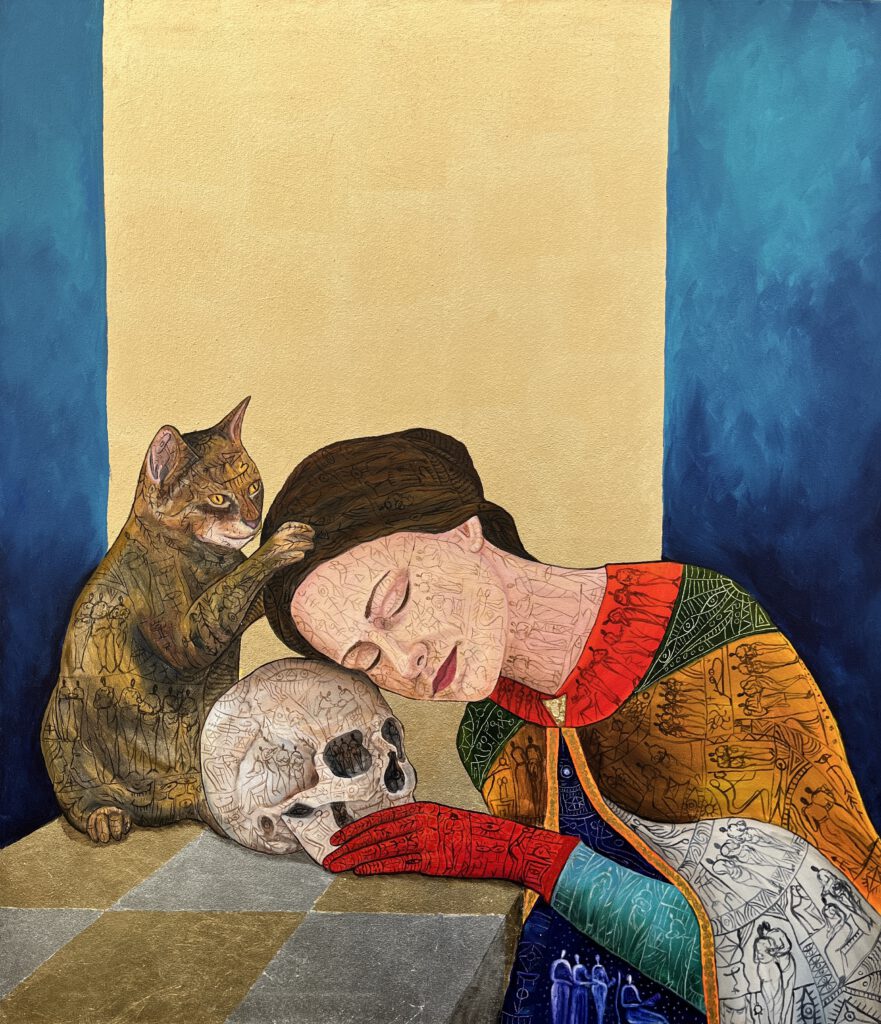
2026 | Acrylic and gold leaf on canvas. | 95 x110 cm
I did not begin Anima Mundi with a predetermined story or the intention of illustrating a particular event. The painting emerged intuitively from an inner world filled with images, voices, emotions, and memories whose meanings I did not fully understand while working.
I was born in a small village near Al-Hasakah in Syria. It was there, at the age of three, that I first began drawing on the clay walls of our home. I still remember the sunlight transforming those walls into golden surfaces, the wheat fields stretching toward the horizon, and the stories that filled our evenings with imagination and mystery.
Over the years, I have lost many loved ones who shared my childhood and its earliest memories. Today, they rest in the soil of that same small village. The place where my life and artistic journey began has also become a place of farewell. Within me, childhood and grief now inhabit the same landscape. Beginnings and endings exist together in a memory that continues to shape my work. When I look at Anima Mundi, I sometimes wonder whether the woman resting her head against the skull might be an unconscious image of my mother. She is a remarkably strong woman who has endured many hardships. I did not consciously intend to portray her, yet perhaps something of her strength, tenderness, and sorrow found its way into the painting.
This uncertainty is an essential part of my creative process. When I paint, the sounds of the outside world seem to disappear. I enter a profound silence between myself and the canvas. Images and voices buried in my memory struggle to reach the surface. The first lines emerge intuitively, and bodies, gestures, colors, and symbols gradually take shape. I do not impose a finished narrative on the painting. Instead, I allow it to reveal itself through the act of painting. Sometimes I only begin to recognize what an image carries after the work is complete.
My paintings are my identity. Through them, my inner world finds its way onto the surface of the canvas. Memories, voices, emotions, and images that live within me gradually become visible. I do not simply paint what I see; I give form to what I carry inside me. Each painting becomes part of who I am, holding memories I recognize and others I have yet to discover.
In Anima Mundi, the table is divided into two colors: gold represents life, while silver represents death. They exist side by side, reflecting the inseparable relationship between existence and mortality. The cat represents both tenderness and life. I am fascinated by the sensitivity of cats and their ability to respond to human emotions, as though they can sense sadness, illness, or happiness. In the painting, the cat offers a quiet presence of warmth and companionship. Yet memory, in my artistic world, does not belong only to human beings.
In my world, everything has a memory. Clothing carries the traces of the bodies that have worn it and those it has encountered. Gloves, objects, animals, and gestures hold their own histories and emotional presence. Nothing exists merely as decoration. Every element carries something of a life, a feeling, or an experience. Even the painting itself has a memory of its own.
The mysterious signs and markings across the figures belong to a personal symbolic language that I continue to discover and develop. They are not codes with fixed meanings, but traces of an inner world where memories, psychological tensions, and images continually transform one another.
Gold has a significance in my work that goes beyond decoration. Its light returns me to my childhood, to the sunlit walls of our home and the wheat fields that once appeared to me like liquid gold. In Anima Mundi, this light becomes part of a dialogue between life and death, presence and absence, sorrow and hope.
I do not see this painting simply as an expression of grief. It is also about the tenderness that survives loss, the strength of those who remain, and the invisible connections between people, animals, objects, and places.
For me, true art emerges from the inner struggle between reason and intuition. Painting allows me to transform what cannot always be expressed in words into a visual language. Through color and light, I seek to create a space in which the viewer can breathe hope, even in the presence of profound human sorrow.
I began painting in the village where many of my loved ones now rest. Perhaps, without knowing it, I am still painting my way back to that place.
And perhaps the painting itself remembers things that I have forgotten.